The dynamic band, and why the threshold is a level
A running average chases the event and lets go while the loud thing is still loud. RIDGE's threshold is a level, so a band that ducks a loud passage keeps ducking it.
What a dynamic band is here
Every one of RIDGE's 24 bands carries its own dynamics section, which means the band can sit still until its frequency does something and then move by a set amount. The detector listens to the band's own shape, deliberately wider than the band itself, so what triggers the move is the region the band works on rather than the whole mix.

The measurement that decided the design
The first version made the threshold the band's own running mean over a second and a half and compared the fast envelope against it. That sounds reasonable and it fails in a specific, audible way, which was measured on a tone held 24 dB above ordinary with nothing else changing:
At a quarter of a second in, a band set to a range of 12 dB down was applying the whole 12 dB, all of it. At one second it was applying 5.11 dB. At two and three quarter seconds it was applying 1.28 dB. Over a four second passage it averaged 5% of what the control said. The band let go while the loud thing was still loud.
The cause was not calibration. A difference is not a level: a reference that chases the event stops seeing an event once the event has lasted a couple of seconds. So the threshold became a level in dBFS, and a level stays under a loud passage for as long as the passage lasts.
Range means what it says
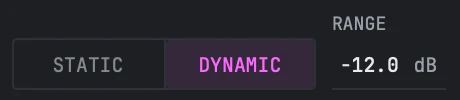
Range is how far the band moves, and there is a second number behind it that makes that sentence measurable. Span is how far above the knee the level has to get for the full range to be applied, and at threshold plus span the applied gain is the range, exactly.
A positive range opens the band when its frequency gets loud. A negative range ducks it. Zero means the section is inert, and inert here means genuinely nothing left over: the followers, the detector and the offset are all cleared, and the filter is rebuilt without the offset in it. An earlier version returned early instead, which left a band whose every on-screen control read zero sitting 7.01 dB off flat on silence for the rest of the session.
The knee is soft and centred on the threshold, so the band starts to move slightly before the threshold rather than switching at it.
Setting one up by hand
Put the band where the problem is
Set the frequency, the shape and the Q first, with the dynamics off. You are choosing what the detector listens to as well as what the filter moves, because the detector follows the band's own shape.
Decide which direction you want
Negative range to duck a frequency when it gets loud, which is the usual case for a resonance or a boxy note. Positive range to open a band only when there is something there to open, which is how you add air to a vocal without adding it to the breath between lines.
Set the threshold as a level
In manual, DynThreshold is a level in dBFS and you type it. Watch the band on the loud material you are trying to catch, then set the threshold under it. Nothing about that number moves once you have set it.
Or let AUTO estimate ordinary
In auto, the threshold is placed against a running estimate of what this band's level ordinarily is, plus an offset you set. The estimate is built so that a resting band is exactly inert.
Set attack and release, or leave them
Auto derives both from the band: attack is two cycles of the band's own frequency, because a follower cannot be faster than the waveform it follows, and release has a floor of 120 ms and stretches with how long the band has been working. A transient still releases in 120 ms, and a band that has been working for a second releases in about three times that. Typed values do not stretch, because a typed number is a promise.


What AUTO is estimating, and why it is not a plain average
Auto is trying to answer "what does this band ordinarily do", and a plain running average gets that wrong in three separate ways, so the follower behind it is not a plain one.
It rises slowly, over about twenty seconds. If the reference climbed to meet a loud chorus in a second and a half, the band would hand the chorus straight back. Twenty seconds is long enough that a chorus stays a chorus and short enough that a genuinely louder section eventually becomes the new ordinary, which is what automatic has to mean.
It falls faster than it rises but still not fast, about four seconds, because material really does get quieter and a threshold that cannot follow it down goes deaf for the rest of the song.
And it does not follow a hole. Below a set distance under its own estimate the reference simply stops updating, because a rest is not the programme getting quieter. A reference that slid down through every gap would come back up under the first note after it and duck something nobody asked to be ducked.
It is also primed: for the first stretch after the band starts, the reference is an exact running mean, so a band switched on in the middle of a song starts at that song's level rather than climbing to it over twenty seconds.
Practical notes
- One switch governs the whole panel. DynAuto decides the threshold, the attack and the release together, so the screen never shows a mixture of typed and derived numbers.
- The detector is wider than the band on purpose. A very high Q band still triggers on the region around it rather than on a single bin.
- The external sidechain is published and inert. Four parameters on every band describe it, a switch, a filter mode and the two frequencies that would narrow what sets the band off, and this version stores and recalls all four without acting on any of them.
- Range zero is a real off. It costs nothing and it leaves nothing behind.
- Bands written by SCAN arrive with a flat static gain and their cut in the range, so they are already dynamic bands and everything here applies to them.
Still stuck?
Nothing here matching? Write to a person.