Coming from Pro-Q
One number reads differently and it is worth thirty seconds. Everything else that matters was measured across 249 cases on the same parameter list.
What this article is for
If you have spent years in another EQ, most of what you know transfers, and the useful thing to know is exactly which parts do not. There is one number to convert, one behaviour that is different on purpose, and a short list of things RIDGE simply does not have. RIDGE and Pro-Q 4 were driven from the same parameter list across 249 cases and measured against each other, so the answers below are readings rather than opinions, and the rows that go against RIDGE are here too.
One number reads differently, and it is worth thirty seconds
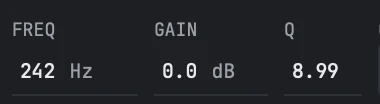
At the same Q number RIDGE's band is narrower than Pro-Q 4's, because RIDGE uses the textbook definition of Q while Pro-Q's dial is softer by a factor of the square root of two: the measured bandwidth ratio is 1/sqrt(2), so RIDGE at Q 2.0 matches Pro-Q at about Q 2.8.
In practice that is one multiplication in each direction. Multiply by 1.41 to go from a Q you knew there to the same width here, and divide by 1.41 coming back. The ratio was read off a grid a ninety sixth of an octave wide across eight Q settings, and it settles on 0.707 exactly once the bands are narrow enough for the textbook relation to hold.
Neither dial is wrong. They are two conventions, and RIDGE stays on the textbook one because moving the dial would shift every preset and every automation lane written against it.
Shelves reach their gain sooner here
The same convention decides the shelves, so they follow from the paragraph above rather than being a separate surprise: at the same Q number RIDGE's shelf is steeper, which means it arrives at its nominal gain closer to the corner frequency.
Measured on a 5 kHz shelf at plus six decibels with Q 1.0, RIDGE reaches ninety nine per cent of nominal at 1.39 times the corner frequency and Pro-Q 4 reaches it at 3.35 times. On a 6 kHz shelf at Q 0.7 the other one does not reach ninety nine per cent below 23.5 kHz at all.
If a shelf you rebuild here sounds more pointed than you expected, that is the number to reach for: widen the Q rather than moving the corner.
What matched, and how closely
Bypass matched at 0.00 dB across the whole test grid, which is the reading that says the two plugins were being compared on the same signal path at all.
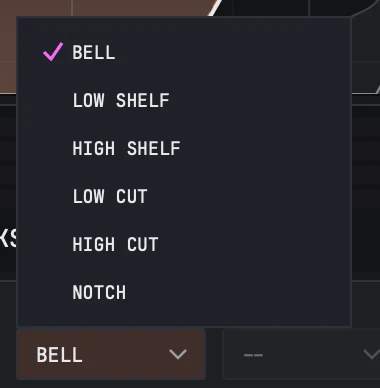
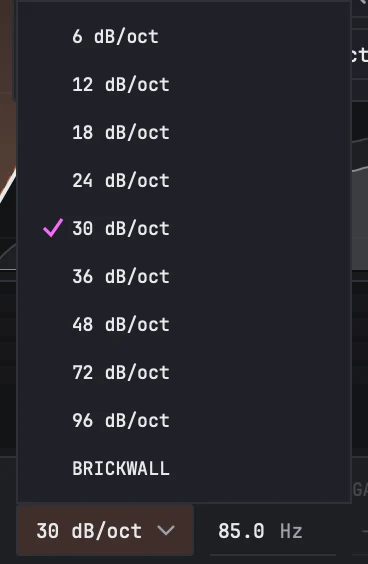
Cut corner frequencies matched to a median of 0.01 dB and bell centres to a median of 0.08 dB. Cuts separate deep in the stopband, worst around 15 kHz and above, where two different ways of turning the same analog prototype into numbers give different answers near the top of the audio range. In the middle of the band it is inaudible.
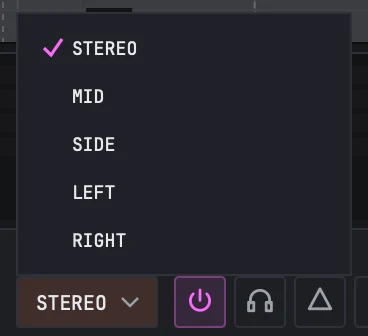
Mid and side placement matched exactly. On the path a band does not touch, the difference was 0.00 dB, which means the placement itself adds no error: a band on mid leaves side alone, fully.
SOLO behaves differently, and it is a decision
Solo a band in RIDGE and both the curve and the sound become that band's band-pass, and the strip says which band is soloed. Solo a band in Pro-Q and the drawing carries on showing the whole curve while the solo is indicated in the well.
This is the largest measured difference between the two plugins and it is not a defect on either side. It is two answers to the question of what solo is for: hearing the band on its own, or hearing the mix with attention drawn to the band. Knowing which one you are getting matters when you switch between them in the same session.

What RIDGE does not have
- Spectral dynamics. Triggering the gain of a single frequency inside a band rather than the band is Pro-Q 4's headline feature and RIDGE does not have it.
- Surround. There is no per band speaker routing and no Atmos support.
- Character or saturation modes. There is no Gentle or Warm stage.
- Formats. RIDGE ships AU, VST3 and a standalone app on macOS 11 or later, Apple Silicon, and VST3 on Windows. There is no AAX, no CLAP and no VST2, so a Pro Tools session or a VST2 only host is out of scope for this release.
- A few small things: output pan, processing resolution, receive MIDI, spectrum grab, and sidechain audition.
- Vintage models. RIDGE has none, which matters if you moved to Pro-Q from something that did.
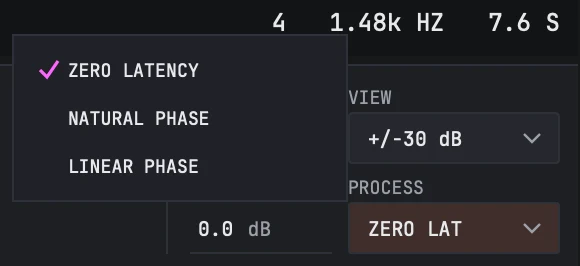
- Linear phase, in this release. PROCESS lists zero latency, natural phase and linear phase, and only zero latency is implemented: pick another and the audio stays on zero latency while the bar prints MODE FELL BACK. If a linear phase pass is part of how you work, that is the row to read twice.

What RIDGE has that you will not have used before
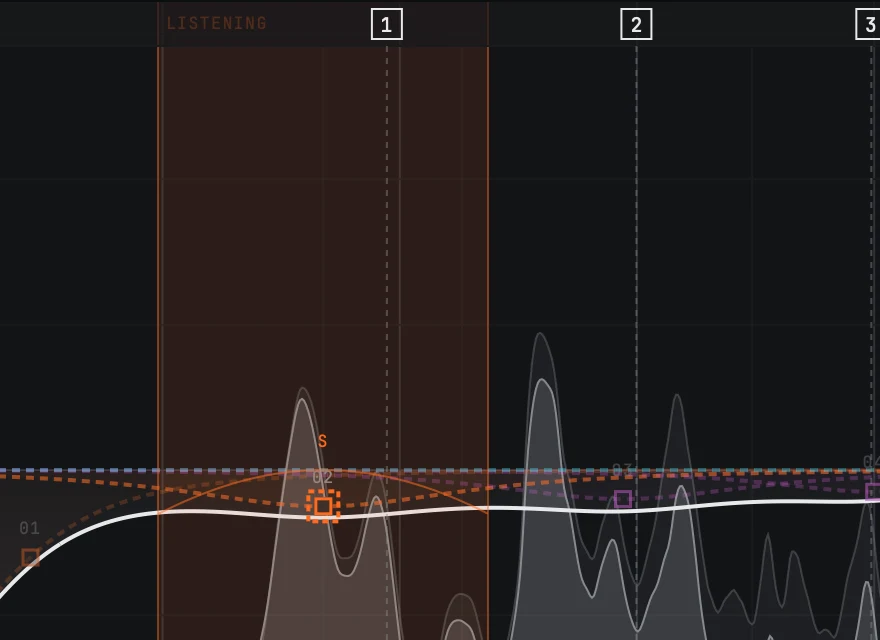
SCAN listens to a take and marks up to eight resonances, and it separates a resonance from a note by how long the frequency stays rather than by how loud it is. The collision indicator you may know from Pro-Q compares two instances against each other; this looks inside one take.
The marks stay on a time axis holding thirty minutes of the session, so a ring is a moment as well as a frequency. Every analyzer in this class, including the one you are coming from, shows you only the present instant.
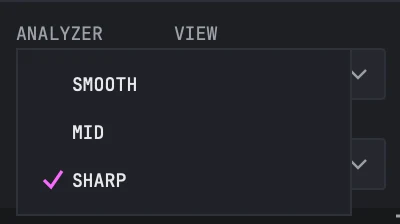
The analyzer has a smoothing control with three steps, which is not a control Pro-Q offers. It opens on the sharpest of the three.

Five parameters that are published and inert
RIDGE publishes 453 parameters and locks the list from the first release, so automation written today reads the same in every version that follows. Four of them belong to the external sidechain group and the fifth is the processing mode, and this version does not act on any of the five.
That is stated rather than hidden: the plugin counts how many of those five you have moved away from their defaults and says so. They are reserved, not coming soon, and the reason they are published at all is that adding parameters later would shift every automation lane written before them.
The short version
- QuestionAnswer
- Do my Q numbers transfer?Not one for one. RIDGE at Q 2.0 matches Pro-Q at about Q 2.8
- Do shelves reach their gain in the same place?No, RIDGE's arrive sooner, and for the same reason
- Is bypass clean?0.00 dB across the test grid
- Does mid/side behave the same?Yes, and the untouched path measured 0.00 dB
- Does solo behave the same?No, and it is a declared difference
- Spectral dynamics?No
- Surround or Atmos?No
- AAX, CLAP or VST2?No
- Linear phase?Listed in PROCESS, not implemented in this release
Still stuck?
Nothing here matching? Write to a person.