PRISM MINI: the GLIDE knob
How long the carrier takes to slide into the next note instead of stepping to it, why the knob opens at 28 ms, and why a fresh instance reads 40.
What the knob decides
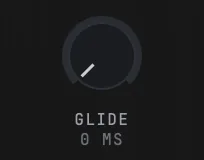
GLIDE is the second knob of the MOUTH group and it decides one thing: how long the carrier takes to arrive at the next note. At zero it steps, which is the sound of a note being replaced. Above zero it slides, which is the sound of a note being reached. The unit is milliseconds and the range runs from 0 to 250 in steps of 1.
No glide
At 0 ms the carrier is at the new note on the same block the engine decides on it. Nothing is wrong with that sound and some material wants it: fast delivery, short syllables, anything where a slide would smear one word into the next. It is also the setting to use when you want to hear what the pitch follower is actually deciding, because nothing is smoothing the decision on the way out.
The default glide
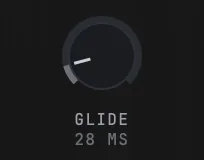
The knob's own default is 28 ms. That number is not the paid plugin's number and it is not a round one: it came out of a measurement of what a real talkbox does, and both sides of the measurement are written down.
One side asks when a slide becomes audible. Five talkbox records were run through a note transition detector, 330 transitions in all, and the median time those records take to settle on a note is 30 ms. The other side asks when a slide becomes late. The widest share of a note that any of those records spends arriving is 3.48%, and applied to PRISM MINI's own note length on the same records through the same detector that comes to 28 ms. The two do not overlap, 30 against 28, and the narrower one wins: being late is a fault, while a shorter slide is only less slide.
Why a fresh instance reads 40
A fresh instance opens on the TUBE slot, and TUBE asks for 40 ms. So the first number you see on the knob is the preset's, not the knob's. Load a different slot and it moves again: CHEST is the longest at 70, CRY is longer still at 90 because a slow arrival is part of what makes it cry, and TEETH is 8, which is nearly a step.
The 28 is still the parameter's own default, which is what a host returns the automation lane to when you reset it, and what the knob carries when no slot has written it. Both numbers are correct and they are answering different questions: 28 is what this control opens at, 40 is what this sound asks for.
What each factory slot asks for
- TUBE, 40 ms. The slot a fresh instance opens on, and a real slide at a middling length.
- CHEST, 70 ms. Low and closed, and the arrival is slow to match.
- CRY, 90 ms. The longest, and the only slot that also moves in time.
- TEETH, 8 ms. Nearly a step, which is what the brightest and most forward slot wants.
Setting it by ear
Start from the delivery rather than from the number. A held, sung line takes a long glide without losing a word, so CHEST and CRY sit where they do. A fast, consonant-heavy line loses intelligibility long before the knob reaches the top, and TEETH is at 8 for that reason. If words are turning into each other, the knob is too high; if the line sounds like a sequence of separate notes rather than a phrase, it is too low.
The stage is the check. The note reading names the note the engine decided on, so at a long glide it tells you where the carrier is heading while the picture shows you how long it is taking to get there.
Still stuck?
Nothing here matching? Write to a person.