PLUNGE controls explained
Every parameter in the PLUNGE voice, from oscillators and drop through envelope, distortion, noise and unison, with its real range and default.
One voice, laid out in signal order
PLUNGE is a single monophonic voice, and its controls follow the signal path: oscillator mix, pitch behaviour, harmonic and noise layers, envelope, then distortion and tone. Reading them in that order is the fastest way to understand why a knob does what it does.
Oscillator mix
- OSC Sine0 to 1, default 1.0
- OSC Tri0 to 1, default 0
- OSC Square0 to 1, default 0
- OSC Saw0 to 1, default 0
Reading the oscillator mix
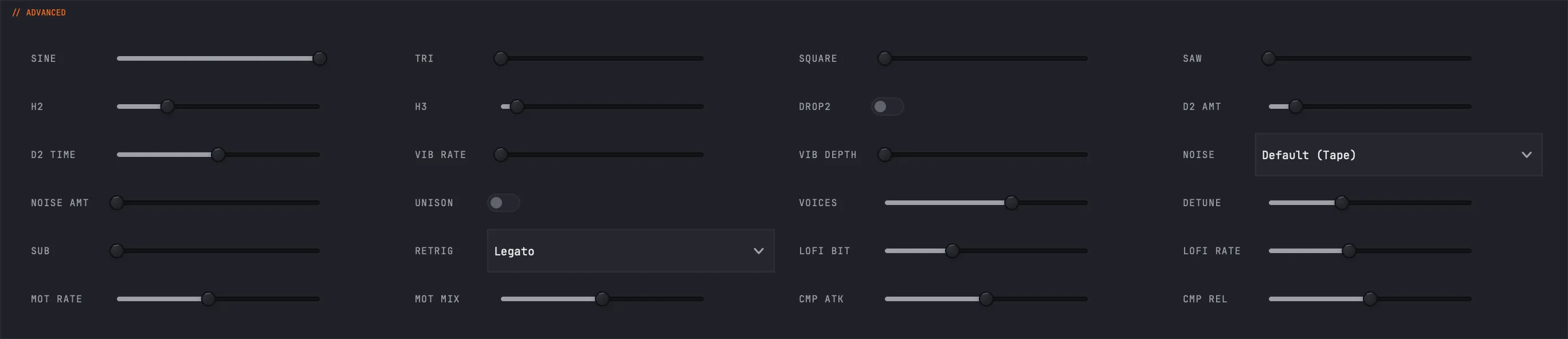
These four are weights, not a selector: you can run sine and triangle together. Sine alone is the classic 808 body; adding triangle and square puts edge into the attack without moving the fundamental. Saw is mostly there for the reese side of the engine.
Harmonics
- Harmonic 20 to 1, default 0.2
- Harmonic 30 to 1, default 0.05
Reading the harmonics
Second and third harmonic sine layers added on top of the fundamental. They are what make an 808 audible on a phone speaker: the fundamental is below what a small driver reproduces, so the ear reconstructs the note from these. Push them when the low end disappears on laptops.
Pitch: drop, second drop, glide
- Drop Amount1 to 4×, default 1.8
- Drop Time1 to 200 ms, default 45
- Drop2 Onoff by default
- Drop2 Amount1 to 4×, default 1.4
- Drop2 Time1 to 300 ms, default 120
- Glide1 to 300 ms, default 80
Reading drop and glide
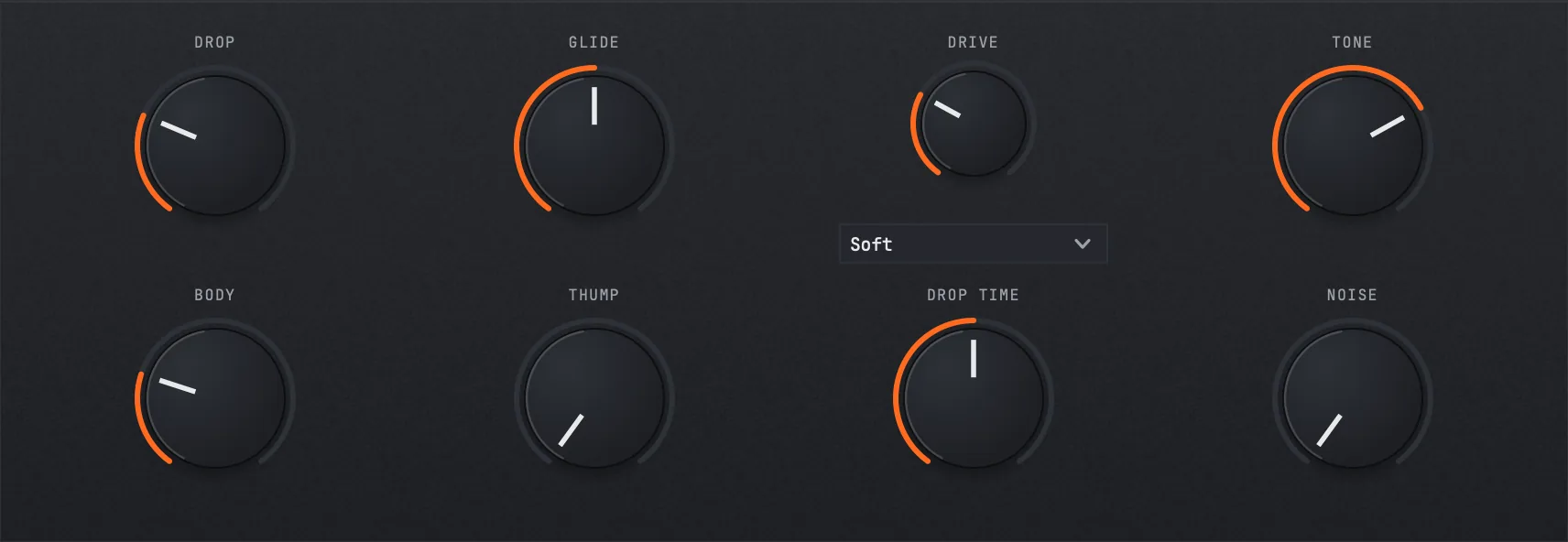
Drop is the per-note pitch dive that gives an 808 its attack: the note starts at Drop Amount times its target frequency and falls to pitch over Drop Time. A short, high drop punches; a long one whoops. Drop2 adds a second, slower stage on top, and that is the two-step feel.
Glide is how long the voice takes to slide from one note to the next. Because PLUNGE is legato and monophonic, overlapping notes glide rather than retrigger; the Retrigger control switches that behaviour if you want each note to start fresh.
Envelope
- Attack1 to 50 ms, default 4
- Release0.05 to 2 s, default 0.9
- Decay Onoff by default
- Decay0.05 to 2 s, default 0.35
Reading the envelope
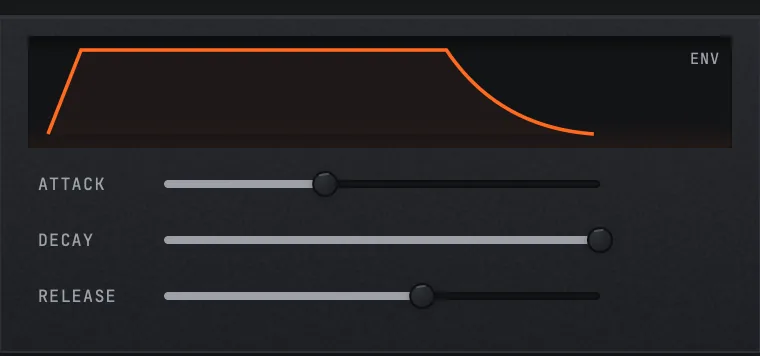
Attack stays short by default because a slow attack on a sub reads as a fade-in rather than a note. Release is the tail after note-off. Decay is optional and separate: turn it on when you want the body to fall away while the note is still held. That is what makes a staccato 808 pattern breathe instead of sustaining flat.
Distortion and tone
- Drive1 to 10, default 1.5
- Dist ModeSoft · Hard · Fold
- Tone200 to 8000 Hz, default 3500
Reading distortion and tone
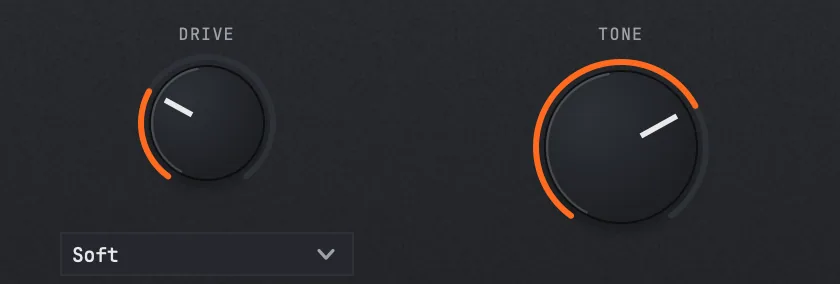
Soft is a saturating curve, Hard is a clip, and Fold wavefolds. Fold is the one that generates new upper harmonics rather than just squaring the ones present, which is why it changes the character rather than the level. Tone is a two-stage low-pass after the distortion, so it tames what Drive created rather than what the oscillators produced.
Layers
- Cowbell0 to 1, default 0
- Noise TypeDefault (Tape) · Tape · Vinyl
- Noise Amount0 to 0.5, default 0
- Thump0 to 1, default 0
- Vibrato Rate0 to 10 Hz, default 0
- Vibrato Depth0 to 0.1, default 0
Reading the layers
Cowbell adds the two metallic partials that define the phonk sound. Noise lays a tape or vinyl bed under the note: the amount knob is the real on/off, and the type names which bed it reaches for. Thump is a short low-mid punch at the start of each note, useful when the 808 is doing the kick's job as well as its own. Vibrato is off in most presets and is there for sustained, sung-sounding lines.
Reese and unison
- Unison Onoff by default
- Unison Voices1 to 9, default 6
- Unison Detune0 to 50 cents, default 18
- Unison Width0 to 1, default 0.6
- Sub0 to 1, default 0
Reading reese mode
Turning Unison on switches the voice from a single oscillator to a detuned stack, and that is reese. Voices sets how many, Detune how far apart in cents, Width how far they spread in the stereo field. Sub adds a mono sine underneath the stack.
The low end stays mono regardless of Width: everything below roughly 110 Hz is summed, so a wide reese still survives a mono club system. You do not have to manage that yourself.
Output and voice mode
- RetriggerLegato · Retrigger
- Output−24 to +6 dB, default 0
Reading the output section
Legato glides between overlapping notes; Retrigger restarts the envelope and the pitch drop on every note. Output is your fader for the instrument. Presets carry their own internal level trim separately, so switching presets does not move the fader you set.
Still stuck?
Nothing here matching? Write to a person.