PLUME's six modes and three eras
What PLATE, SILK and CHAMBER do in each era, how the SPACE modes STONE, MIST and VOID differ, and what happens to the tail when you switch.
Two families, one field
PLUME's six modes come in two families that are built differently. CLASSIC holds PLATE, SILK and CHAMBER, and every one of them comes in three eras, WARM, CRISP and CLEAN, so the family has nine settings in all. SPACE holds STONE, MIST and VOID. The eras belong to CLASSIC only, and VOID comes in two densities instead.
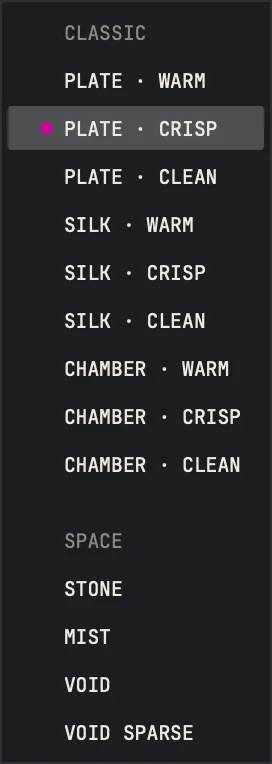
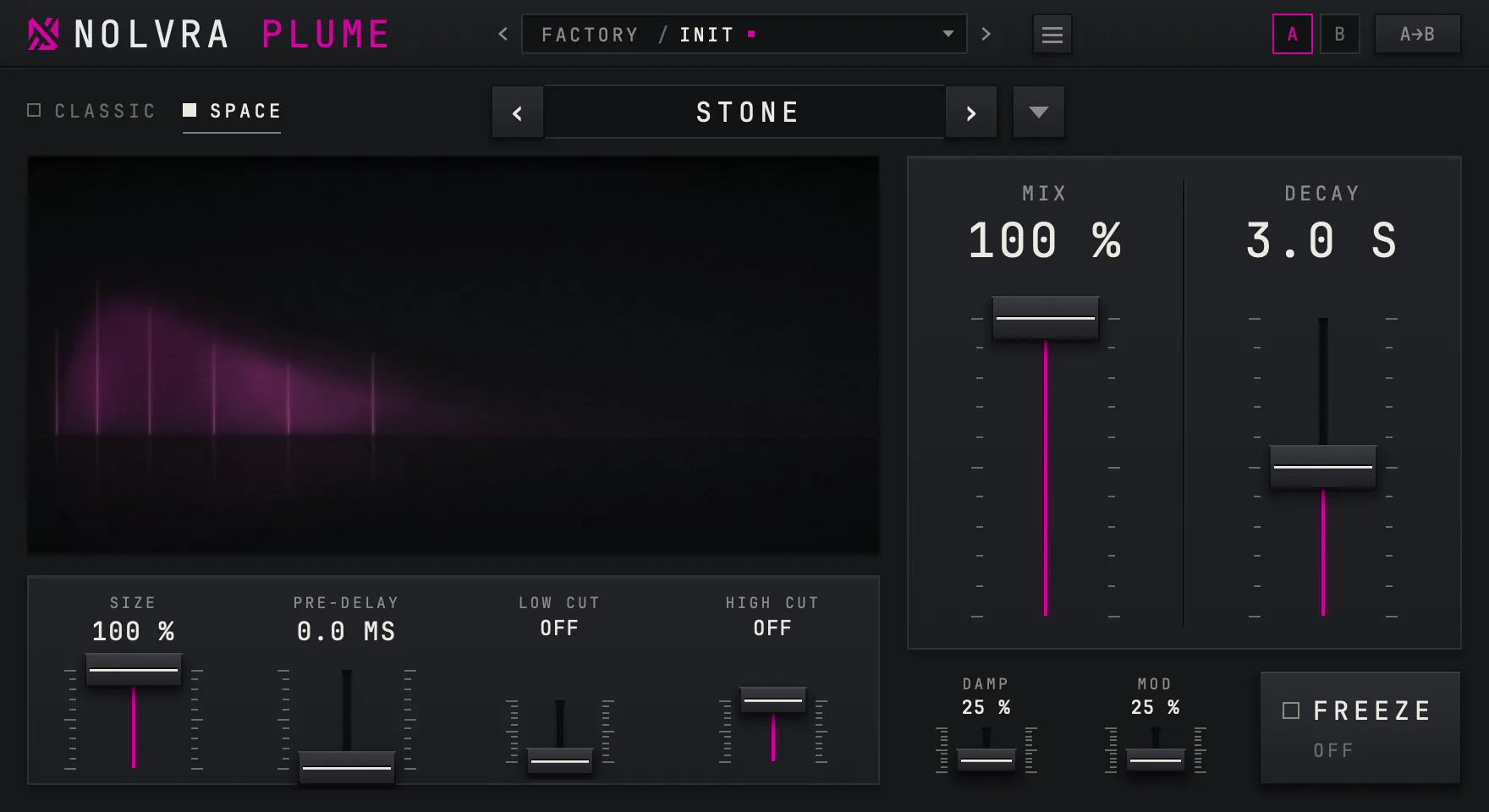
All of it is chosen in one place: the mode field at the top. CLASSIC and SPACE choose the family, the arrows step inside it, and the triangle opens the full list.
Choosing a mode
Choose the family
Click CLASSIC or SPACE at the top left. Going back to SPACE returns you to the SPACE mode you used last.
Step or open the list
The arrows beside the mode field step through the family you are in and wrap around at the end. In CLASSIC they walk all nine pairs of mode and era in order, PLATE · WARM, PLATE · CRISP, PLATE · CLEAN, then SILK and CHAMBER the same way. In SPACE they walk STONE, MIST, VOID and VOID · SPARSE, as the field writes the last one. The triangle at the right of the field opens every setting of both families at once.
Listen to the tail, not the first second
A new mode starts with an empty tail, so give it a moment of signal before you judge it. The next sections say why.



The three CLASSIC modes
PLATE is the clean one of the three. Its tail is linear: playing louder makes it louder and nothing else, so it keeps the same colour from a whisper to a shout.
SILK and CHAMBER both have a soft saturation stage inside the tail loop, so a loud input thickens the tail rather than only raising it. CHAMBER also opens up its diffusion as the input gets louder.
PLATE is also the only CLASSIC mode with FREEZE. In SILK and CHAMBER the saturation inside the loop would slowly drain a frozen tail, so FREEZE is greyed out there instead of holding something that fades.
The three eras
The era changes how the tail is computed, not a tone control on top of it.
CLEAN runs the tail at your session's sample rate with every moving delay smoothly interpolated.
CRISP also runs at your session's rate, but two of the five moving delays inside the tail step instead of gliding, which leaves a little noise in the movement.
WARM runs the tail at half your session's rate. The top of the tail stops at around 11 to 12 kHz at a 48 kHz session, so it stays darker than that however you set HIGH CUT.
In SILK the WARM and CRISP eras go further: the tail also passes a reduced-bit converter stage and a low-pass filter, at 8 kHz in WARM and 15 kHz in CRISP. SILK in CLEAN has neither.
The three SPACE modes
STONE and MIST are built the same way, each with its own tuning. DECAY sets the length of their tail, and both have FREEZE.
VOID is built differently. DECAY has no effect on it, and the fader dims while VOID is lit to say so; the other controls, DAMP and MOD included, still act. VOID comes in two densities, and they are two rows of the mode list: VOID and VOID SPARSE. Once chosen, the second one reads VOID · SPARSE in the mode field. VOID has no FREEZE.



DAMP and MOD follow the family
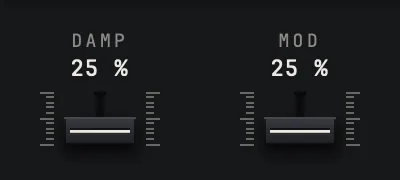
The two small faders beside FREEZE are two different pairs of controls that share one place on the face. In CLASSIC, DAMP is a high shelf inside the tail, from OFF down to -24 dB, and MOD is how far the tail's delays move, in percent. In SPACE, DAMP and MOD are the SPACE engine's own damping and movement on a 0 to 100 % scale.
Each family keeps its own pair. Moving DAMP in STONE does not move the CLASSIC DAMP, so switching back to PLATE finds it where you left it.
Switching while the music plays
Every change of mode, era or VOID density starts a second reverb engine for the new setting and crossfades the old one out over 50 ms, so the switch does not click. The old tail does not carry over: the new engine starts empty and fills from the signal that arrives after the switch. On sustained material you hear the tail rebuild; on a gap between phrases you hear nothing at all.
A change of mode also turns FREEZE off, because a held tail belongs to the mode that froze it.
Questions this page answers
- The tail cut out when I changed the mode. That is by design: a new mode starts with an empty tail after a 50 ms crossfade.
- There is no era in SPACE. WARM, CRISP and CLEAN exist for PLATE, SILK and CHAMBER only.
- DECAY does nothing in VOID. The dim fader is telling you so; shape VOID with the other controls.
- FREEZE is greyed out in SILK, CHAMBER and VOID. It works in PLATE, STONE and MIST.
- The arrows never leave the family. Use CLASSIC and SPACE, or the list, to cross over.
Still stuck?
Nothing here matching? Write to a person.