Widening a vocal or a pad without a phase problem
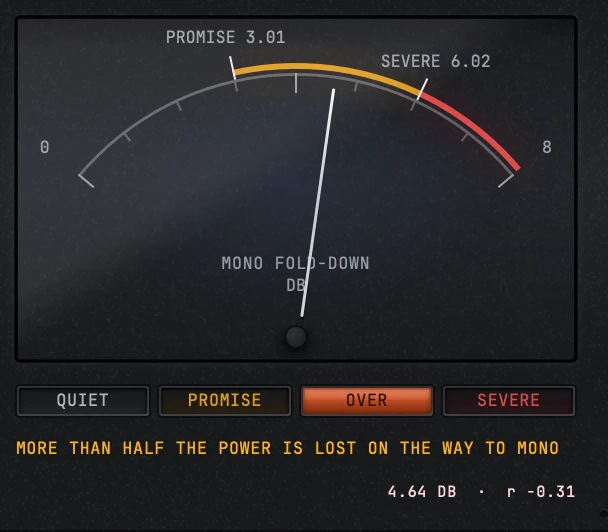
Width here is a level on the side signal, not a delay, so it cannot smear a transient or hollow out a centre. What it can do is cost you the fold-down, and the gauge is where that shows up.
The phase problem this plugin does not have
Widening has a bad reputation, and it is deserved by a particular mechanism: a delay on one side, a short Haas offset, an all-pass on one channel and not the other. Those make a wider picture by putting the two channels out of step with each other, which is why they smear transients and why the result can disappear in mono.
None of that is what happens here. Width is a level on the side signal. The side signal is what is already different between your two channels, and turning the knob makes that difference louder or quieter without moving anything in time. There is no delay stage in the engine.
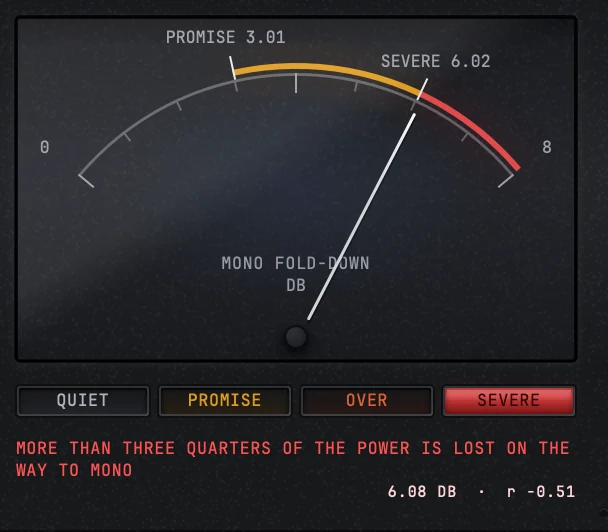
The one thing widening does cost you is the fold-down, and that cost is not hidden. It is printed on the gauge in dB while you work.
Why unity is genuinely unity
The mid signal is split into three bands and summed again even though all three of its band gains are 1.00. That looks like wasted work and it is the reason this plugin can be trusted at unity.
A Linkwitz-Riley crossover pair sums to an all-pass rather than to a flat wire. If only the side signal went through the network, it would come back phase-rotated against an untouched mid signal, and the image would shift at width 1.00, before you had touched anything. Running both through the identical network keeps them locked to each other: at unity the output is the input through one all-pass, the same one on both channels, so correlation, level and image are exactly where they were.
The three way split needs one more all-pass to stay complementary. The mid and high bands sum to an all-pass at the upper crossover applied to the high-passed signal, so the low band is fed through a matching all-pass at that same frequency. Without it the low band arrives at the wrong phase and the sum dips around the lower crossover. With it the total is flat.
A pad, a synth or a wide bus
Check that there is something to widen
Solo the band's S column. If it is silent, the source is mono and nothing here will change that: width multiplies the side signal, and a mono source has none. This plugin does not synthesise width, and a stereoizer is not one of the things it does.
Open the band the instrument actually occupies
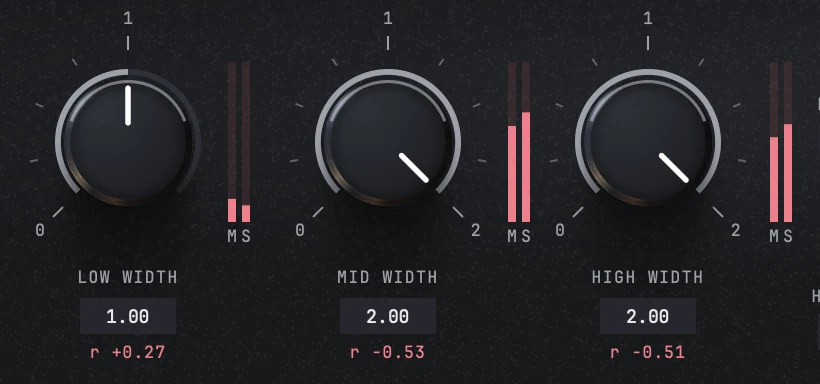
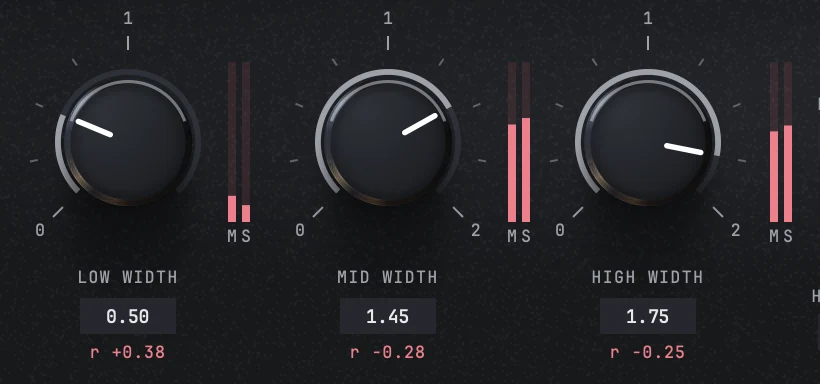
For a pad or a supersaw, most of what makes it wide lives above the low crossover, so the move is MID WIDTH and HIGH WIDTH rather than a single global one. SYNTH SPREAD is the shelf's own version of this: 0.50 at the bottom, 1.45 in the middle and 1.75 on top with the lines at 120 Hz and 1.6 kHz. It is the widest setting on the shelf and the gauge is there precisely because it is.
Anchor the bottom on the way up
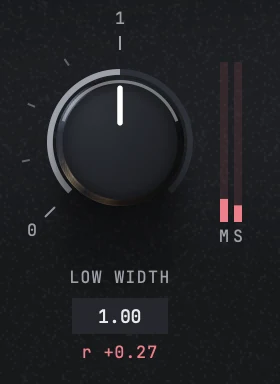
Take LOW WIDTH down as you take the others up. It costs almost nothing in stereo, it costs nothing at all in mono, and it buys back most of the fold-down that opening the top two bands just spent. Widening the low band is not available, so the only direction it has is the useful one.
Read the r under the knob you moved
Each width knob prints its band's own correlation underneath it, computed after the width has been applied. When that number goes negative, that band's side energy has passed its mid energy, which is the same threshold the first line on the gauge marks. One band in the negative and two comfortably positive is a normal, healthy result. All three negative is a mix that will not survive a mono system.
A vocal
Widen the bus, not the voice
A lead vocal is usually mono at the source. What makes a vocal sound wide is the material around it: doubles, harmonies, a stereo delay, a reverb return. Put IMAGER on the bus that carries those, not on the dry voice, and you have something to work with.
If the vocal is being crowded, narrow the crowd
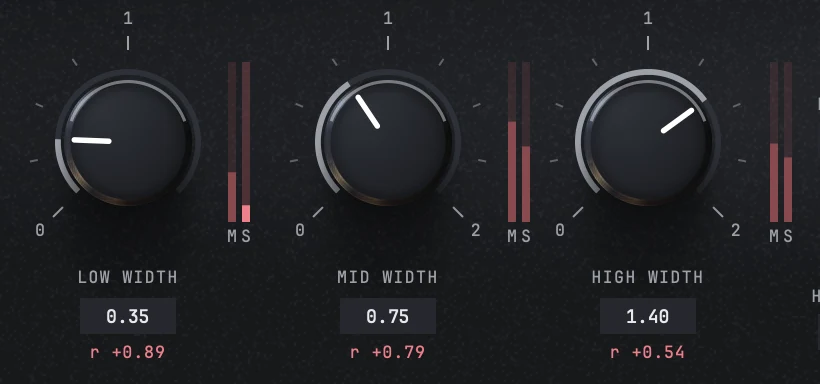
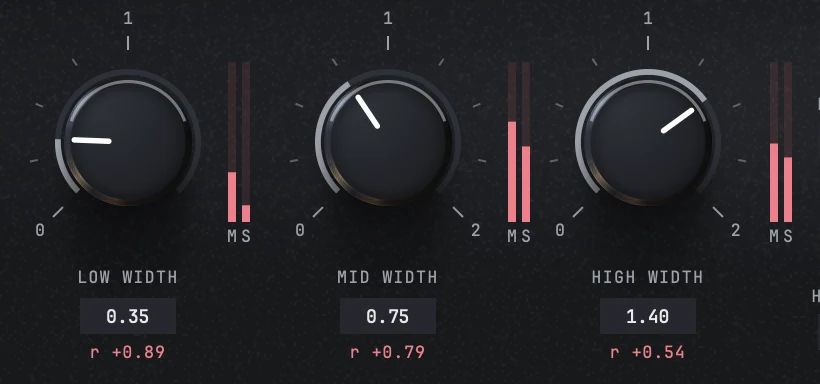
This is the move most people reach for backwards. When a lead is being pushed out of the middle by wide guitars or synths, the answer is usually to pull the band the voice lives in toward the centre and open the air above it, so the mix keeps its size while the vocal keeps the middle. CENTRE HOLD is that setting written down: 0.35 in the low band, 0.75 in the mid with the line at 200 Hz, and 1.40 in the high band above 4 kHz. Note that the band containing the voice goes below unity, not above it.
Use BUS LIFT when the bus is just narrow
For a group of keys, guitars or backing vocals that sits too small behind the lead and needs air rather than surgery, the gentler position is 0.90, 1.20 and 1.40 with the lines at 110 Hz and 2.2 kHz.
What you hear
Turning a width up makes the sides louder while the centre stays exactly where it is. On a pad that reads as the instrument opening around the middle of the mix rather than moving forward, because nothing about the centre changed. On a bus with a real double or a stereo reverb it reads as the room getting wider.
Turning a width down makes the sides quieter with the centre again standing still, so a narrowed bus does not get quieter in mono. It gets quieter in stereo only, by exactly the amount of side content you removed.
DELTA is the check worth learning here. It plays the output minus the same material at unity width, which is precisely what your knobs added or took away and nothing else. If a move sounds large and DELTA sounds like almost nothing, the move was mostly imagination.

Things worth knowing before you push a width past 1.50
- The plugin will not stop you and it will not quietly correct you. An automatic guard existed once and was measured out because it moved the level most on the material it helped least. Warning was judged better than silent correction, and that decision is settled.
- The honest consequence is that this plugin can be pushed past its own first line on real material, and it says so while it happens.
- A mono source stays mono at any width. If the S column is silent, the knob has nothing to scale.
- The gauge reads the whole output, not the band you are working on. Use the per band r to find which band is responsible, then fix it there.
- A wide setting that reads WITHIN PROMISE on a sparse verse can read SEVERE on the chorus. Set width on the densest section the record has.
- Nothing in the monitor section can move the reading, so you can leave MONO or a solo engaged while you work without wondering whether it is affecting the number.
Still stuck?
Nothing here matching? Write to a person.