Keeping the low end in mono
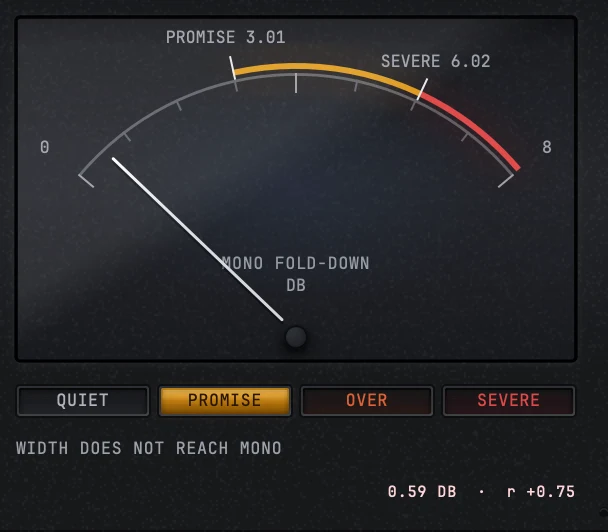
Collapsing the bass to mono does not make it quieter on a mono system. It removes the part a mono system was never going to get, and the gauge shows you what that was worth.
Why the low band is the one with a ceiling
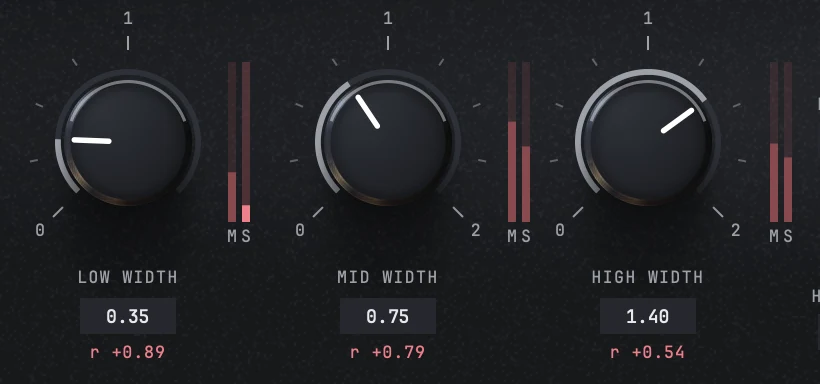
LOW WIDTH runs 0.00 to 1.00 while the other two run 0.00 to 2.00. The band can be taken all the way to mono and it cannot be widened at all, and that is deliberate: below the low crossover, fold-down loss stops sounding like a slightly narrower image and starts sounding like a bass line that has gone missing. The plugin refuses to sell that trade rather than warning about it.
The ceiling sits on the parameter itself rather than inside the engine. It is decided before a sample arrives, it never moves with the programme, and your host, your presets and your automation lane all see the same limit, so a wide automation curve cannot cross it quietly.
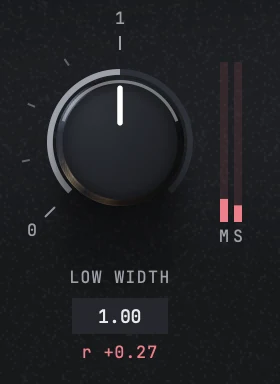
What collapsing the low band actually does
This is the part that surprises people, and it comes straight out of the topology.
Width here is a gain on the side signal. The mono sum is the mid signal, and every band of the mid signal runs at unity no matter where the width knobs are. So the mono level does not move when you turn a width knob, in either direction.
Take LOW WIDTH to 0.00 and the bass a mono system receives is exactly what it was going to receive anyway. What you have removed is the part of the low end that only ever existed in stereo, and that is the same part that was going to cancel on the way down. In stereo you lose a little size at the bottom. In mono you lose nothing at all, and the gauge falls, because the loss reading is a ratio of side energy to mid energy and you have just taken side energy out of it.
That is also why no width setting can put a dip in the mono sum. The three bands of the mid signal are always at unity and always sum flat, so there is no crossover notch waiting for you down there.
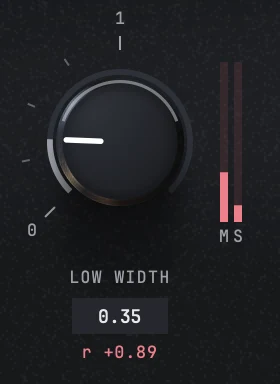
Doing it on a real mix
Put the crossover where the problem is, not at a round number
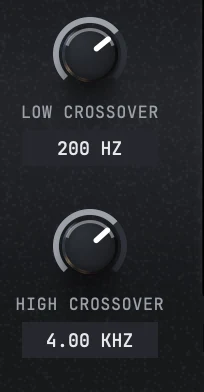
LOW CROSSOVER opens at 120 Hz and runs 40 Hz to 400 Hz. The control is skewed so that single hertz are reachable near the bottom of the range, because that is where this decision is actually made. On a kick and sub record the line usually wants to be under the sub's fundamental and above nothing else. On a full band mix it is often higher than people expect, because the bass guitar's body and the low end of a room mic are both in play. Start at 120 Hz, then move the line rather than the width and listen for the point where the bottom locks together.
Solo the low band's side before you decide anything
Click the S column under LOW WIDTH. That is the low band's side content on its own, and it is usually the fastest answer in this whole article: if there is nothing down there you would miss, the decision is already made. If there is a wide sub bass patch or a stereo reverb tail carrying real information, you now know what taking it out will cost. Click the same column again to turn the solo off.
Bring LOW WIDTH down and watch two numbers
The gauge is the first. The second is the correlation printed under the LOW knob itself, which is that band's own reading rather than the whole mix's, and it is what tells you whether the bottom was the thing responsible. There is no need to go to 0.00 for the number to move. The band's side level meter reports what the band contributes after the width has been applied, so the bar under the knob comes down with the knob and you can see the trade being made.
Check it in mono, then check it in stereo
MONO folds the output with the same sum the gauge measures, so it is the honest version of the test. What you are listening for is whether the bass is still there and still even. Then release MONO and listen to whether the mix lost anything you cared about. If it did not, the move is free.
What you hear
On most material, taking the low band to mono is inaudible in stereo and audible only as a bass line that stops moving around. On material with a genuinely wide bottom, a stereo synth bass or a doubled 808 spread by an earlier plugin, you will hear the bottom get smaller and more solid at the same time.
The one thing you should not hear is a level change. If the bass gets quieter when you narrow the low band, the level you were hearing was side content that a mono system was never going to reproduce, and you have just found out what your mix does on a phone.
The factory presets that make this move
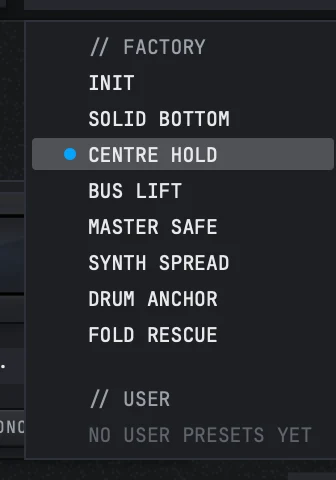
- SOLID BOTTOM takes the low band to 0.00 at 140 Hz and opens the two above it. It is the setting for a record going to a club or a lathe.
- FOLD RESCUE takes it to 0.00 at 220 Hz and pulls the other two bands under unity as well. It is the one to reach for when the gauge is already saying OVER PROMISE or SEVERE and the bounce is due.
- DRUM ANCHOR sits at 0.30 with the line at 180 Hz, which anchors a kick and snare while leaving the overheads open above 3.5 kHz.
- MASTER SAFE sits at 0.40 with the line at 150 Hz, and CENTRE HOLD at 0.35 with the line at 200 Hz.
- BUS LIFT only touches the bottom lightly, 0.90 at 110 Hz, because a group bus usually needs air rather than surgery.
- Every one of those numbers is a starting position. The crossover in a preset is as much a part of it as the width, and both are yours to move.
Still stuck?
Nothing here matching? Write to a person.