Reading the mono fold-down, in dB
The gauge is not a taste control. It is the level your mix loses when something sums it to mono, measured at the plugin's own output, against two lines drawn where the arithmetic changes.
What the number is
Most of the rooms a record gets played in sum it to mono at some point: a phone speaker, a club system with one of its sides down, a lathe, a bar television. What survives that sum is the mid signal, and what does not survive it is the side signal. The gap between the two is a level, and the gauge prints it.
The reading is positive when level is lost, and it is measured at the plugin's own output rather than predicted from the knob positions. That means it is always a figure about what you are actually sending down the chain, and it moves the moment the mix moves.
Where the two lines come from
Both of the printed lines are arithmetic rather than taste, which is why they are printed on the scale instead of being left to a colour.
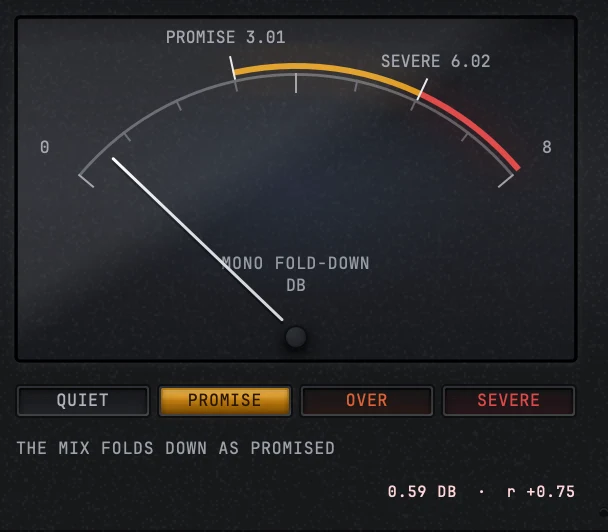
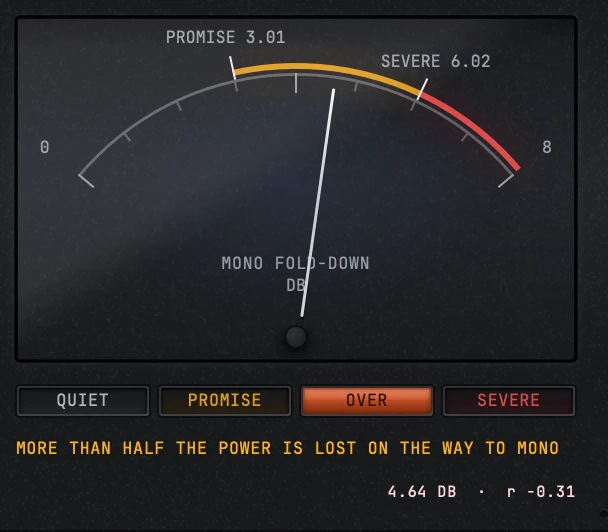
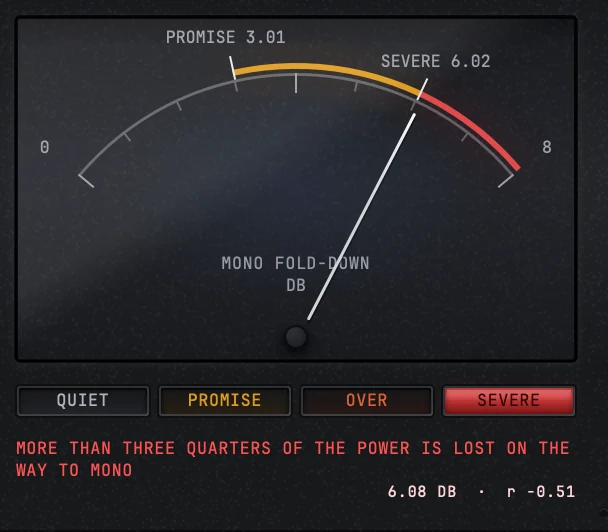
PROMISE 3.01 is 10 times log10 of 2, which is the point where the side energy equals the mid energy. Correlation is zero there and half the power is gone on the way to mono. SEVERE 6.02 is 10 times log10 of 4, correlation minus 0.50, and three quarters of the power is gone.
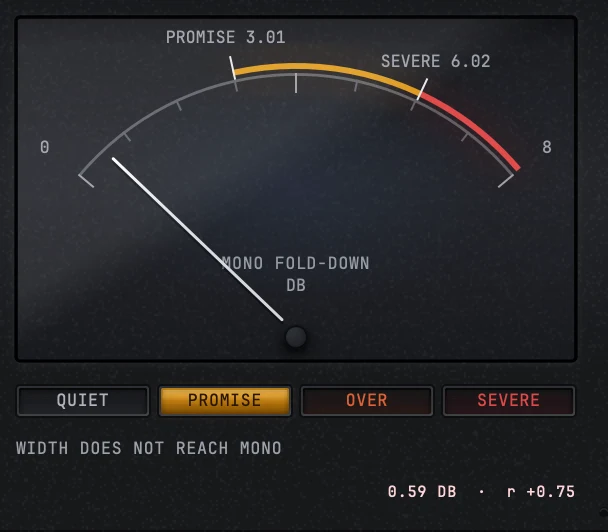
Under the first line the plugin says WITHIN PROMISE, which it spells out as the mix folding down as promised. Between the two it says OVER PROMISE, which it spells out as more than half the power being lost on the way to mono. Above the second it says SEVERE, which is more than three quarters. Those are the product's own four sentences and they live beside the code that decides which one is true, so no surface can word them differently.
QUIET is the fourth word, and it is not a fault
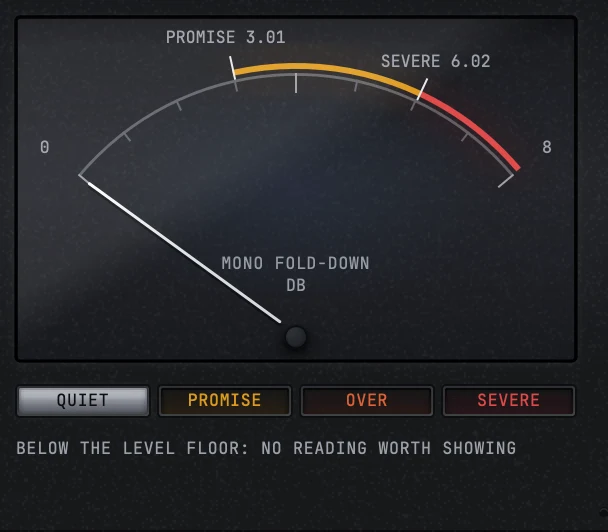
Below a stereo RMS of minus 60 dBFS the plugin stops printing a figure and says QUIET instead. That is a decision with a reason behind it: down there the programme is not really playing, the ratio is measuring the tail of a reverb against nothing, and an indicator that goes red between sections is an indicator people learn to ignore.
There is a fifth state and it is about time rather than level. The meters are written from the audio callback and only from there, so if the transport stops, the last reading would otherwise sit on the face over silence. After a quarter of a second with no audio block the reading is called stale and clears itself. An ordinary gap between blocks is about a fifth of that, so normal playback never trips it.
Using the reading
Read it before you touch a knob
Put the plugin on the bus and play the loudest section without changing anything. Whatever the gauge says now is what the material does on its own, and it may already be past the first line. That figure is your starting point, and it is not something this plugin did.
Move one width and watch the number, not the knob
Widening raises the side energy, and the reading is a ratio of side energy to mid energy, so the number goes up. Narrowing does the reverse. Work in the band that is actually responsible: turn one width, watch the gauge, and put it back if the cost is larger than the gain.
Press MONO to hear what the number is about
MONO folds the output down with the same sum the gauge is measuring, so it is the ear's version of the reading rather than an approximation of it. A mix that reads OVER PROMISE and still sounds like itself in mono is a different situation from one that loses its whole bass line, and only one of those is a problem.
Press DELTA to hear what you added
DELTA plays the output minus the same material at unity width, so what you hear is exactly what the width knobs did and nothing else. With the bypass engaged it is silent, by arithmetic rather than by a rule.
Decide, and let the number be the record of the decision
The plugin does not correct the fold-down for you. It prices it. A reading over the line that you understood and accepted is a decision, and a reading over the line you never looked at is the reason the bounce sounds small in a car.


What you hear, and what the reading will not do
None of the three listening controls can change the number. That is structural rather than a promise: the indicator taps the signal before the monitor section, so DELTA, MONO and a solo all sit downstream of the measurement and cannot reach it. A soloed band is a way to hear one part of the reading, not a way to change it.
The number lags the music by design. The window is 600 ms, and that length was measured rather than picked: six candidates between 100 ms and 3000 ms were swept, and 600 ms is the longest one that still warns inside a bar at 120 bpm while never landing on the wrong side of a line compared against the offline table. Shorter windows disagreed with the table and longer ones took well over two seconds to notice a section change.
The correlation printed beside the reading is the same measurement seen a different way. It is exact when the two channels carry the same energy and off by exactly their imbalance when they do not, which is why the dB figure and not the correlation is what the gauge is built around. Under each width knob there is a second correlation, that band's own, so a broadband reading you cannot explain can usually be traced to one of the three.
Practical notes
- A positive reading is a loss. There is no version of this number where more is better.
- Silence reads 0.00 dB, and that is true rather than a placeholder: nothing folds down to nothing without loss.
- The band meters and the gauge run on different windows, 150 ms and 600 ms, because one is following the material and the other is making a judgement about it.
- The reading is taken after the plugin, so a plugin after this one can still change what actually leaves the chain. Put it last if the last word is what you want to read.
- A reading that sits between the lines on a dense chorus and under them on a verse is normal. Watch the section that matters for the release, not the average.
- FOLD RESCUE is the factory preset written for the case where the gauge is already saying OVER PROMISE or SEVERE and the bounce is due.
Still stuck?
Nothing here matching? Write to a person.